
What do earwigs look like?
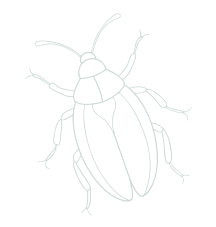
- Earwigs are dark brown to black with a red head and pale yellow-brown legs.
- Size: 1/4 – 1 inch long,.
- Long, flattened body usually with two pairs of wings (hind wings are fully developed and folded beneath the short, leathery front wings).
- Thread-like antennae approximately half the length of the body.
- Most notable characteristic—a “pincer-like” appendage at the end of the abdomen.
- “Pincer-like” appendages are known as the forceps.
What are the habits of earwigs?
- Earwigs are typically outdoor insects which can become household pests if they invade homes or structures—typically during the fall or night-time.
- Earwigs have a foul, unpleasant and noticeable odor when crushed (as a function of alarm pheromone secretions).
- Females lay multiple batches of approximately 50 eggs within a nest-like shallow depression beneath a wooden board or stone.
- Developmental time from egg to adult is typically 56 days.
- Females display a mothering, protective instinct. Thus, they protect, the nest and the nymphs until they have reached their second molting phase.
- Though they usually live outdoors and feed on vegetation, earwigs are general feeders, and therefore rarely do much damage to any particular plant.
- Earwigs are increasingly active at night and are reclusive during the day.
- Earwigs are not considered harmful to humans despite their name and some species are attracted to lights.
What should I look for when identifying earwig problems?
- Earwigs found indoors are generally found in cracks/crevices, under thresholds, under furniture and under carpeting—particularly if the subfloor contains moisture.
- On the exterior, earwigs can be found along mulch-beds, under pavers, stepping stones, wood piles, landscape/hardscape timbers, rocks, etc…
How do I get rid of earwigs?
- Outdoor harborages that are moisture-prone should be removed.
- The yard should be regularly mowed, keeping weeds and tall grasses to a minimum.
- Flower beds should not be over-mulched and mulch should be changed seasonally.
- Ideally, a barrier that is vegetation-free should be maintained at a length of 8-to-24-inches around the perimeter of structures or homes.
- Areas of extreme moisture should be considered for close inspection and environmental remediation (drying of moist areas).
- Insecticides can be applied to targeted areas to destroy readily visible earwigs.
- Exclusion or sealing of entry points into buildings should be performed—caulking gaps around siding, windows, doors, pipes, wires, etc.
- A vacuum should be used to remove visible or accessible earwigs.
- Yellow bug-lights or sodium vapor lighting is less attractive to earwigs than traditional lighting.
Contact our entomologist-trained team of specialized pest control applicators to help you eliminate earwigs quickly.